 +34 941743964
The ultimate guide to industrial printers: types, uses, and buying tips
Choosing the right industrial printer can mean the difference between a smooth, efficient production process or a string of errors, delays, and rework—with the inevitable loss of money, of course.
In this guide, we’ll clearly and thoroughly explain everything you need to know about industrial printers: the different types, how they’re used, the industries that rely on them, and how to choose the best one for your business.
What is an industrial printer?
Industrial printers are devices designed to print information directly onto products, packaging, or surfaces during the manufacturing process. This information can be variable (such as expiration dates, batch numbers, QR codes) or fixed (like logos, text, or branding).
They’re commonly used in industries like:
- Food and Beverage
- Pharmaceuticals and Cosmetics
- Automotive and Components
- Electronics and Appliances
- Logistics and Packaging
Most common types of industrial printers
The ideal printer depends on the product, production speed, and material to be printed. Here are the main technologies:
1. TIJ (Thermal Inkjet) industrial printers
These printers use heat to eject ink onto the surface. They’re ideal for high-resolution coding on both porous and non-porous surfaces.
Advantages:
- Clean and precise printing
- Low maintenance
- Easy to integrate into production lines
Best for: packaged food, pharmaceuticals, cosmetics.
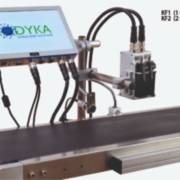
At Kodyka, we specialize in manufacturing TIJ 2.5 printers—an ideal evolution for efficient, high-clarity coding.
2. DOD (Drop On Demand) industrial printers
These printers release ink droplets only when needed. Commonly used for large formats or irregular surfaces.
Advantages:
- High-speed performance
- Great for porous materials
Best for: cardboard boxes, wood, sacks.
3. Industrial laser printers
These printers don’t use ink. They mark products by burning or discoloring the surface with a laser beam.
Advantages:
- Permanent and tamper-proof
- No consumables required
- Extreme precision
Best for: plastics, metals, glass.
4. TTO (Thermal Transfer Overprint) technology
Used to print on flexible film, especially in plastic packaging.
Advantages:
- High-quality printing
- Perfect for delicate materials
Best for: snacks, vacuum bags, labels.
Common business uses of industrial printers
Industrial printers are essential for traceability, regulatory compliance, and consumer confidence. Common use cases include:
- Expiration dates
- Batch numbers
- QR or DataMatrix codes
- Barcodes
- Brand logos
- Production data (shift, machine, operator)
How to choose the right industrial printer
Before purchasing a printer, consider the following:
Surface type:
Are you printing on plastic, glass, cardboard, metal, or flexible film? Each technology performs differently based on the material.
Production line speed:
Fast lines require printers that can maintain legibility without slowing down the process.
Required resolution:
Do you need scannable codes, sharp logos, or just readable numbers? This directly impacts the technology you should choose.
Maintenance and consumables:
Factor in the total cost of ownership: ink prices, cartridge or printhead durability, and ease of maintenance.
Practical tips before investing
- Run a print test: Not all inks behave the same on all materials.
- Talk to an expert: At Kodyka, we offer tailored technical support.
- Evaluate after-sales service: A breakdown can cost more than the printer itself.
- Plan for scalability: Choose a printer that can grow with your production needs.
Benefits of choosing a specialized manufacturer
Working with a supplier that develops both industrial printers and custom inks is a huge advantage. At Kodyka, we manufacture:
- High-resolution TIJ 2.5 printers
- Inkjet inks for all surface types
- Tailor-made industrial traceability solutions
This allows us to offer fully integrated solutions customized to your real production needs.
Technology and quality in every print
Today’s industry demands traceability, speed, and accuracy. Industrial printers are not just accessories—they’re a critical part of the production chain.
Want to learn more about our solutions?
Explore our high-resolution TIJ printers, browse our inkjet ink catalog, or dive into our personalized traceability technology.


